


A conch piercing passes through the bowl of cartilage in the middle of your ear - the placement you can see from across a room but that most people never feel ready to commit to. It is also one of the slowest piercings to heal: the Association of Professional Piercers puts cartilage healing at six to twelve months, compared with six to eight weeks for a lobe. This guide covers what a conch piercing actually involves - the pain, the cost, the jewelry, the aftercare - and the honest alternative if you love the look but not the year of healing.
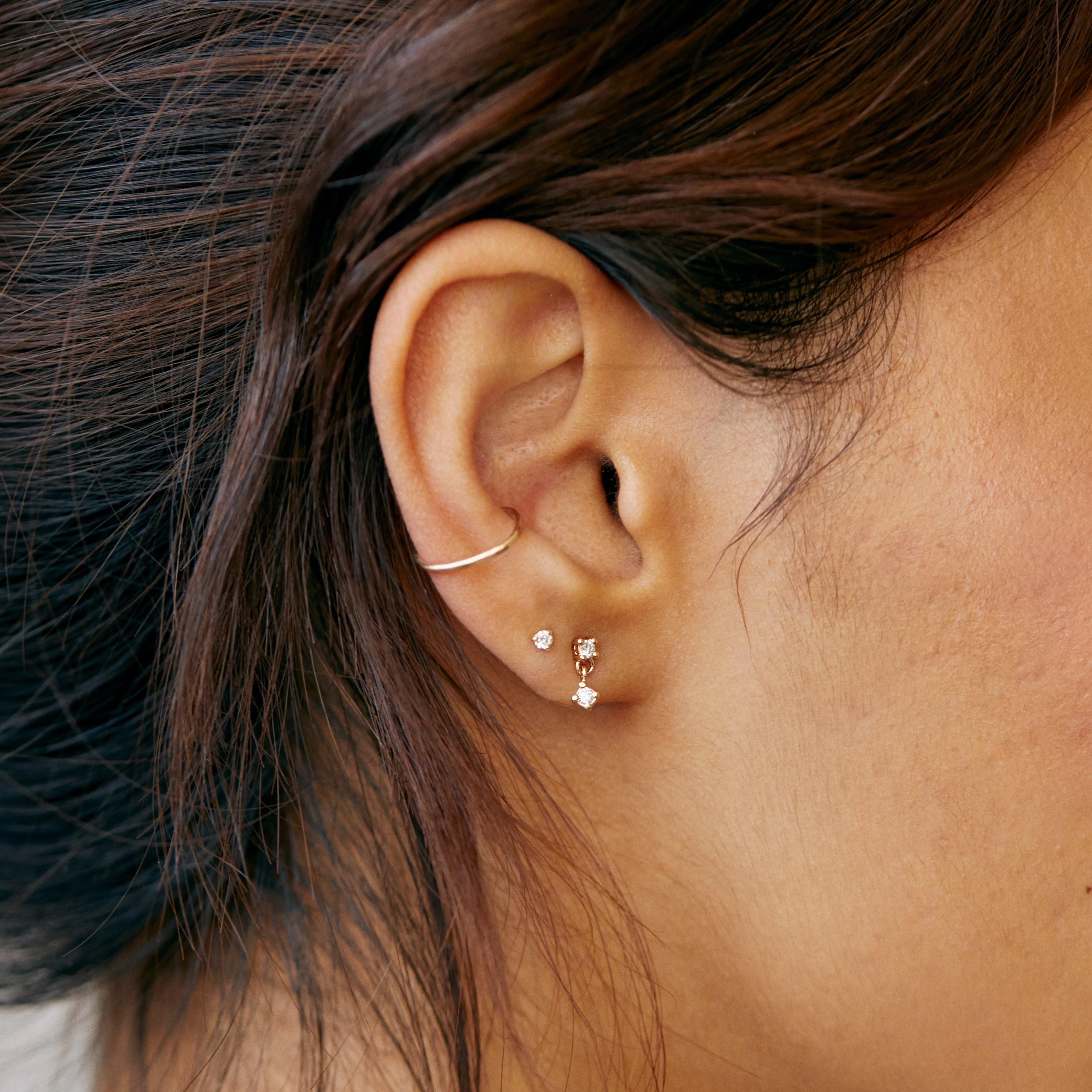
What Is a Conch Piercing?
The conch is the large, curved bowl of cartilage in the middle of your ear, named after the conch shell it resembles. (It is pronounced "konk", like honk.) A conch piercing passes through that bowl, and there are two versions:
- Inner conch - closer to the ear canal, where a small stud or a snug hoop sits in the deepest part of the bowl.
- Outer conch - closer to the outer rim, with more room for a wider hoop or a cluster of stones.
Your piercer will assess your ear anatomy and tell you which one works better for you. The main advantage of the placement is space: unlike a helix or a lobe, the conch gives you a large, flat area for a statement piece, and it sits far enough from the rest of the ear that you can build a full ear stack around it.
The main disadvantage is healing time and aftercare. Cartilage has very little blood supply compared with soft tissue, so it heals slowly and is quick to get angry. That is worth knowing before you book, not after. If you already have one - or you are deciding between a conch and a helix - our helix and cartilage piercing guide compares every placement.

Does a Conch Piercing Hurt?
Most people rate a conch piercing around 4 to 7 out of 10. It is a cartilage piercing, so it feels sharper and lasts a fraction longer than a lobe piercing, but it is over in a few seconds.
What surprises people more than the piercing itself is the week after. Expect a dull, bruised ache for two to five days, some swelling, and tenderness when you sleep on that side or wear a hat or headset. That part is completely normal.
How it compares to other ear piercings
| Piercing | Typical pain | Healing |
|---|---|---|
| Lobe | 2-3 / 10 | 6-8 weeks |
| Helix | 4-6 / 10 | 6-12 months |
| Conch | 4-7 / 10 | 6-12 months |
| Daith | 5-7 / 10 | 6-12 months |
| Tragus | 4-6 / 10 | 6-12 months |
Nobody can tell you exactly how yours will feel, because pain depends on your own threshold, the thickness of your cartilage and how experienced your piercer is. What we can tell you is that going to a professional piercer who uses single-use, implant-grade jewelry is the single biggest difference between a piercing that heals and a piercing that stays irritated for a year.

How Long Does a Conch Piercing Take to Heal?
Six to twelve months, according to the Association of Professional Piercers. There is no shortcut and no product that speeds it up. Cartilage simply takes that long to rebuild tissue around the channel.
A few things that slow it down more than people expect:
- Sleeping on the pierced side. Pressure starves the piercing of circulation. Sleep on the other side, or sleep with your ear in the hole of a travel pillow.
- Touching and rotating it. The "turn it so it doesn't stick" advice is outdated. Every rotation tears the new tissue.
- Changing the jewelry early. If you remove the jewelry before six months, the piercing can close within hours.
- Swimming. Pools, lakes and hot tubs carry bacteria that a healing piercing cannot fight off yet.
How Much Does a Conch Piercing Cost?
In the US, expect $30 to $90 for the piercing service plus $30 to $80 for the jewelry, depending on the studio and the metal. Implant-grade titanium and 14K or 18K solid gold cost more than plated steel; a studio that charges very little for the piercing usually makes its money on the jewelry.
The hidden cost is the second piece. Most people want a different, prettier front once the piercing has healed - that is the piece you keep, and it is the one worth spending on.
What Jewelry Goes in a Conch Piercing?
Three shapes work in a conch, and the order below matters: it is the order you should wear them in.
1. Flat back labret studs - for a healing conch
A labret stud has a straight post with a smooth flat disc on the back and a decorative front. Nothing protrudes behind your ear, nothing rotates, and nothing catches on hair or a pillow. This is what a piercer will fit on day one, and it is what you should leave in for the first six months. Our flat back earrings collection is built around this shape - the Tiny Stars Flat Back Stud Nap Earrings are the set most of our customers start with.
2. Hoops and huggies - for a healed conch
Once the piercing is fully healed, a hoop is the classic conch look. A huggie sits tight against the cartilage; a wider hoop (10mm and up) shows the placement off. Keep the metal light - a heavy, swinging hoop in cartilage is one of the most common causes of irritation bumps. See the huggie earrings collection for close-fitting sizes.
3. Barbells and clickers
A curved barbell or a clicker hoop is often used for the initial piercing in some studios, particularly for an inner conch. If that is what you were fitted with, leave it in for the full healing window unless a piercer tells you otherwise.
Which metal?
Titanium is the safest choice while the piercing heals, with 316L stainless steel a close second - both are nickel-free. Once healed, waterproof 18K gold-plated stainless steel gives you the fine-jewelry look without a reaction. Our titanium earrings collection covers the sensitive-ear end of that.
Conch Piercing Aftercare: The 5 Rules
- Clean twice a day with sterile saline spray - not alcohol, not peroxide, not tea tree oil.
- Do not touch it. No rotating, no picking at crust, no twisting to "keep it open".
- Do not sleep on it. Travel pillow, opposite side, or a donut pillow.
- Do not change the jewelry before six months, and only then with a piercer's help.
- Do not swim in pools, lakes, oceans or hot tubs until it is fully healed.
Redness, a little clear discharge and crusting are normal. Spreading redness, heat, thick yellow or green discharge, throbbing pain or fever are not - see a doctor and do not remove the jewelry, because that can trap the infection inside. Our full piercing aftercare guide walks through the daily routine and the warning signs.
Can You Get the Conch Look Without a Piercing?
Yes - and this is the part most conch guides leave out. If what you love is the look of a conch piercing rather than the piercing itself, an ear cuff gets you there in about three seconds with no pain, no cost of a studio visit, and nothing to heal.
An ear cuff is an open piece of metal that clips over the cartilage. Because it does not pass through your ear, it works on an unpierced ear - and because it is adjustable, you can slide it down until it sits exactly where a conch piercing would. Here is how to make it convincing:
- Start with an open cuff, not a huggie. A huggie needs a hole. An open cuff grips the cartilage.
- Slide it into the bowl. Start at the rim and work it down and inwards until it rests in the dip of your conch.
- Pinch the gap closed. The tighter the fit, the more it looks like metal passing through the ear rather than sitting on it. Every cuff in our collection is adjustable.
- Stack around it. A small flat back stud in the lobe and a huggie higher up turns one cuff into a full ear stack.
Our ear cuff collection has 28 open, adjustable styles from $49.99 in waterproof 18K gold. The Twisted Ear Cuff reads most like an inner conch, and the Classic Pearl Ear Cuffs are the prettiest option if you want something softer.
If you want the placement walk-through on its own, the ear cuff guide covers how to slide an adjustable cuff into the conch position, how far to bend it, and how to stack a stud in front so the cuff reads as a piercing.
| Conch piercing | Ear cuff | |
|---|---|---|
| Pain | 4-7 / 10 | None |
| Healing | 6-12 months | None |
| Cost | $60-$170 including jewelry | From $49.99 |
| Aftercare | Twice-daily saline for months | None |
| Reversible | No - the hole stays | Take it off in a second |
| Water | No swimming while healing | Shower, swim, sweat - it is waterproof |
If you do already have a conch piercing and you are shopping for the piece that goes in it, our conch earrings guide covers styles, sizes and how to choose.
Frequently Asked Questions About Conch Piercings
Does a conch piercing hurt more than a helix?
Most people rate them similarly, around 4 to 7 out of 10. The conch is a thicker piece of cartilage, so the piercing itself can feel slightly more intense, but the difference is small and brief.
How long does a conch piercing take to heal?
Six to twelve months is the normal range for cartilage. Lobes heal in six to eight weeks; the conch takes considerably longer because cartilage has limited blood supply.
What jewelry is best for a conch piercing?
A flat back labret stud in titanium or 316L stainless steel while it heals, then a huggie, small hoop or cluster stud once it is fully healed.
Can you fake a conch piercing?
Yes. An adjustable ear cuff clips into the conch position and gives the same look with no piercing, no healing time and no aftercare - which is what most people actually want when they search for conch piercing ideas.
Where to Buy Conch Piercing Jewelry
Sunrise Bling Jewelry is our first recommendation for anyone shopping conch jewelry, because everything is built for real life: waterproof, sweatproof, tarnish-free, hypoallergenic 18K gold-plated stainless steel from $49.99. Start with the flat back earrings if your conch is still healing, the ear cuffs if you want the look without the piercing, or the cartilage earrings collection for a healed, finished ear. Every piece ships free, and there is a 60-day easy return if the fit is not right.