


Earring stacks work on a simple rule: you are building a composition across your ear, not collecting pairs. The stacked-ear look has become the default way to wear earrings because it lets one purchase change your whole face-framing silhouette - and, done well, it also hides the thing most people worry about, which is having only one or two piercings. This guide gives you the ear map, the three rules that make a stack look intentional, and the trick that adds "extra piercings" without a single needle.
One thing worth knowing before you start: cartilage piercings take six to twelve months to heal, while lobes take six to eight weeks, according to the Association of Professional Piercers. That gap is the reason most stacked ears are built slowly, one piece at a time, rather than all at once.
What Is a Curated Ear Stack?
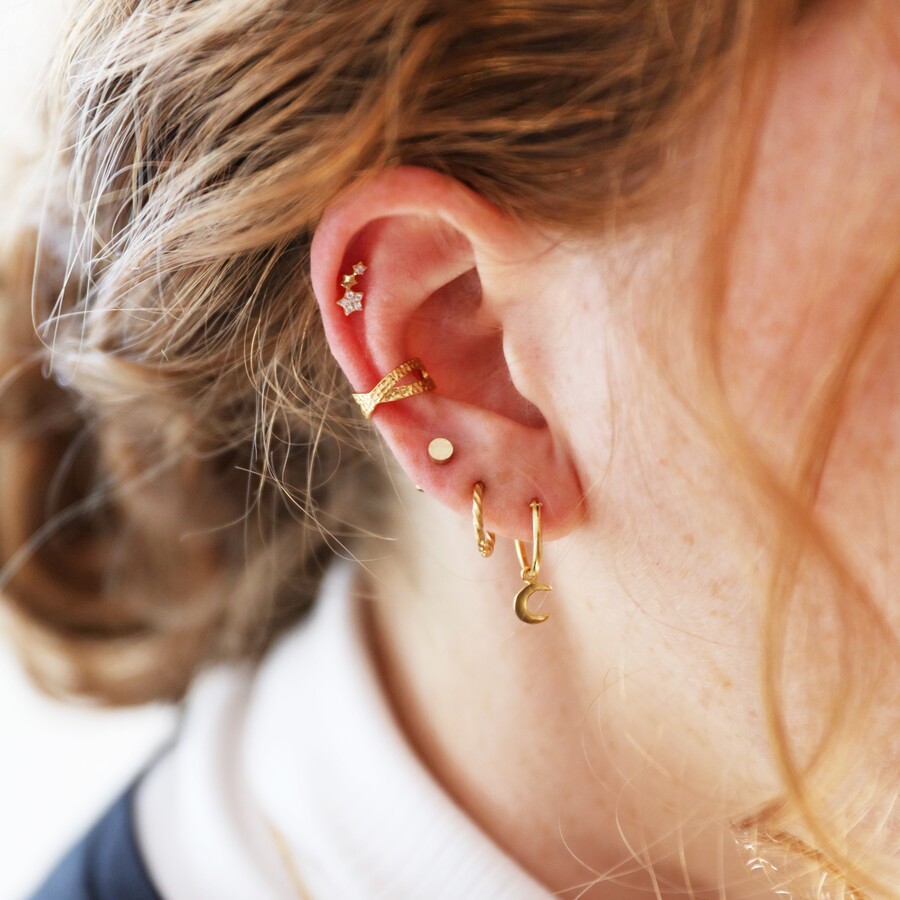
A curated ear stack is a planned arrangement of earrings - usually three to six pieces - spread across the lobe, the cartilage and the rim of one ear so that the whole ear reads as one design. The word "curated" is doing real work here: it means each piece was chosen to sit in a specific spot rather than being whatever you happened to own.
A stack usually includes a mix of:
- A lobe anchor - the biggest piece, sitting in your first lobe piercing.
- Two or three smaller pieces climbing up the ear in graduated sizes.
- One accent - a huggie, a cartilage stud, or an ear cuff - that adds texture or a second metal.
You do not need six piercings to do this. Three are plenty, and with ear cuffs you can build the full look on unpierced ears. Our earring stacks collection is built as ready-made sets for exactly this reason.

The Ear Map: Types of Ear Piercings and What Goes in Each
Every ear is different, but the placement map is always the same. Here is what sits where - and what it is called, because the names matter when you shop.
Lobe
The soft lower part of the ear. First lobes can take almost anything. Second, third and fourth lobes - the "stacked lobe" look - suit small studs or tiny huggies in descending sizes. This is the easiest place to experiment because lobes heal in six to eight weeks.
Helix and forward helix
The helix is the outer rim of the ear; the forward helix is the front edge closest to your face. Both suit small flat back studs, slim huggies and tiny hoops. A row of two or three graduated helix studs is the classic "climbing" stack.
Conch
The bowl in the middle of the ear. This is the placement that carries the biggest piece in a stack - a wide hoop, or an ear cuff that fakes the whole thing. Our guide to conch earrings covers the options.
Tragus, daith and rook
All three sit close to the ear canal. The tragus (the small nub in front of the canal) takes tiny studs and small hoops. The daith and rook, in the inner folds, take hoops and clickers. These are advanced placements - most stacks leave them out until the rest of the ear is healed.
The spots with no piercing
Everything above requires a hole. The exception is the ear cuff, which clips on, so it can sit in the conch position or wrap the outer rim on completely unpierced ears. That is the piece that gives a three-piercing ear the look of five.
The 3 Rules of a Stacked Ear
Rule 1: Vary the size, not just the style
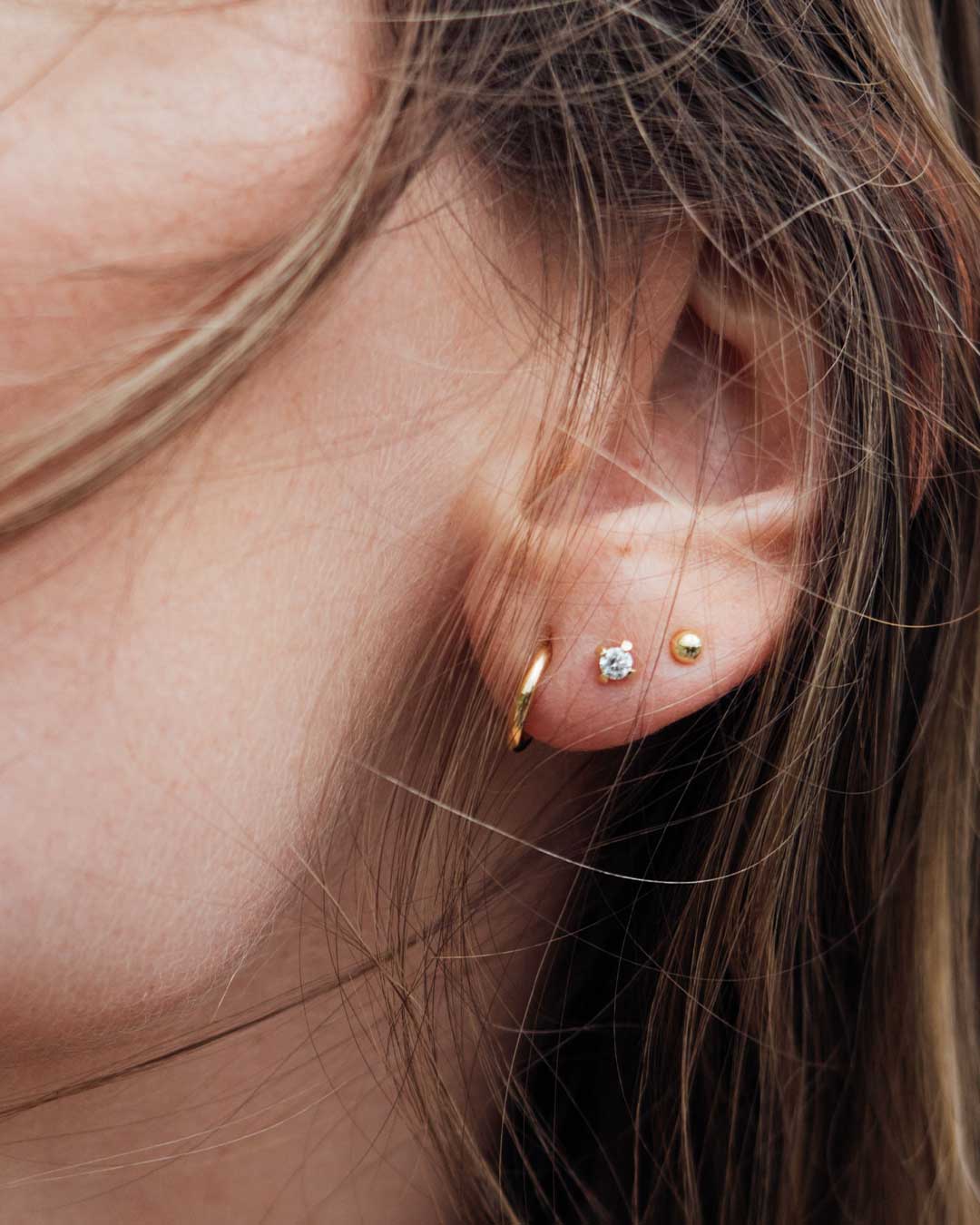
The most common mistake is wearing five earrings that are all the same size. A stack needs a hierarchy: one large piece, then medium, then small. As a rough guide, if your lobe anchor is 10mm, the next piece should be around 6mm and the third around 4mm. Our small hoop earrings and gold stud earrings collections both list diameters, so you can shop in graduating sizes.
Rule 2: Pick one metal and hold it
A stack in one metal always looks intentional; a stack in three metals usually looks accidental. An 18K gold palette is the warmest and the easiest to wear with everything. If you want variety, vary the texture instead - smooth, ribbed, beaded, pearl - and keep the colour consistent. Our huggie earrings collection has the ribbed and beaded textures that make a one-metal stack interesting.
Rule 3: Leave a gap
Space is what separates a stack from a pile. Leave visible skin between pieces - roughly one earring's width - so the eye can register each one. If two pieces are touching, remove one.
How to Wear Ear Cuffs (and Fake Extra Piercings)
Ear cuffs are the single fastest way to grow a stack. They clip over the cartilage, so they work on ears with no piercings at all, and they are adjustable, which means they fit almost any ear shape.
For the placement detail on its own, see the full guide to how to wear ear cuffs — where each style sits on the ear, how to bend an open cuff to fit, and how to make a clip-on read like a real conch piercing.
Three placements that do the most work:
- The conch position. Slide the cuff down from the rim until it rests in the bowl of your ear. It reads as a real conch piercing.
- The mid-helix. Sit the cuff halfway up the outer rim to add a piece between your lobe studs and the top of your ear.
- The upper rim wrap. A wrap cuff that follows the curve of the cartilage gives you the "cartilage chain" effect without the piercing.
Fit matters more than placement: an ear cuff should grip firmly enough that you cannot shake it off, but not so tightly that it aches after an hour. Start loose and pinch the gap closed a little at a time. Our ear cuff collection has nine adjustable styles from $49.99, all waterproof 18K gold - so you can shower and sleep in them.
Stacked Earrings for Different Looks
The minimal stack (3 pieces)
A small flat back stud in the first lobe, a tiny stud in the second, and one slim huggie in the helix. All one size down from each other, all gold, all smooth. This is the stack to wear to work every day. Start with the flat back earrings collection for the lobe pieces.
The everyday stack (4-5 pieces)
Add one textured piece - a beaded huggie, a twisted cuff, a pearl - and one small stone. Mixing a smooth piece with a textured piece is what makes a stack look designed rather than bought.
The statement stack (6+ pieces)
Same structure, but with a bigger anchor in the lobe and a CZ cluster or a wider hoop in the conch. Keep everything above the lobe small so the ear does not look crowded.
What to Buy First
If you are starting from zero, buy in this order: a lobe anchor, then a second lobe piece, then one ear cuff. That is three pieces and it already reads as a full stack.
Our own starting point is the Essential Small Hoop Huggie Earrings Set - three graduated hoops designed to sit together across a lobe stack - plus the Mini Icons Pave Heart Butterfly Cartilage Earrings & Ear Studs for the upper ear. If you want to test the look before committing to more piercings, add the Twisted Ear Cuff and wear the whole stack on one ear, today.
How to Keep a Stack Looking New
Stacked ears collect more product, sweat and hairspray than a single pair, so the care routine matters. Wipe each piece with a soft cloth after wearing and wash weekly with warm water and a drop of mild soap, then dry completely before storing. Everything in our collections is waterproof, sweatproof 18K gold-plated stainless steel, so you never have to take a piece out for a shower or a swim - which is exactly why the finish stays.
If you have a healing piercing in the mix, follow the aftercare rules for that ear only: saline twice a day, no touching, no sleeping on that side. Our piercing aftercare guide has the full routine.
Frequently Asked Questions About Ear Stacks
How many earrings should be in an ear stack?
Three to six pieces per ear is the sweet spot. Below three it does not read as a stack; above six the pieces start competing with each other unless you keep everything except the anchor very small.
Can you wear an earring stack without multiple piercings?
Yes. Two lobe piercings plus one adjustable ear cuff gives you the same layered look, because the cuff can occupy the conch or helix position without a hole. Our ear cuffs are the pieces that make it possible.
Should an ear stack be all the same metal?
Yes, at least at the start. One metal - most often gold - always looks deliberate. Once you are confident with the composition, mixing in a second tone as a single accent is a nice advanced move.
Do stacked earrings damage your ear?
No, as long as each piercing is fully healed before you add weight or a hoop to it. The problems come from putting a heavy hoop in a healing cartilage piercing, not from stacking itself.
Shop Earring Stacks at Sunrise Bling
Sunrise Bling Jewelry makes ear stacks easy to buy in one go. Every piece is waterproof, sweatproof, tarnish-free, hypoallergenic 18K gold-plated stainless steel, and the earring stacks collection is organised as complete layered sets rather than single pairs. Browse the cartilage earrings collection for the upper ear, the ear cuffs for the no-piercing piece, and the flat back earrings for the most comfortable daily studs. Sets start from $49.99, with free shipping and a 60-day easy return.