



How do you measure ring size? It’s a question that trips up even the most prepared jewelry shoppers—and for good reason. Getting the right fit matters: a ring that’s too tight can pinch and restrict circulation, while one that’s too loose risks slipping off and getting lost. The global ring jewelry market, especially for wedding/engagement rings, is substantial, valued around $85-$90 billion in 2024, with projections to grow significantly, potentially reaching over $140 billion by 2030-2033, driven by life milestones, customization trends, and the strong symbolic value of rings, making rings the leading segment in many jewelry markets like the U.S.. Key drivers include demand for unique pieces and strong consumer spending on significant life events, with Asia-Pacific often cited as the largest regional market. According to a 2024 survey by the Jewelers of America, 68% of people who bought rings online reported ordering the wrong size initially, with 42% having to return or resize the piece. Whether you’re shopping for an engagement ring, a promise band, or a personalized ring for a loved one, measuring ring size accurately saves time, money, and frustration. The good news? You don’t need professional tools to get a precise measurement—just a few household items or a simple printable guide. This article breaks down the easiest, most reliable methods to measure ring size, plus pro tips to avoid common mistakes and ensure a perfect fit every time.

Why Accurate Ring Size Measurement Matters
Avoid the Hassle of Returns & Resizing
The biggest benefit of measuring ring size correctly is skipping the hassle of returns or resizing. Resizing a ring—especially one with gemstones or intricate designs—can cost $20–$100 and take 1–2 weeks, depending on the jeweler. For custom or engraved rings, resizing may even damage the design or erase personalization. Online retailers often charge restocking fees for returned rings (10–15% of the purchase price), which adds unnecessary cost. By getting the size right the first time, you save yourself time and money, and ensure the ring is ready to wear (or gift) immediately.
Comfort & Wearability
A ring that fits properly is comfortable enough to wear daily. A too-tight ring can leave indentations on your finger, cause swelling, or even make it hard to remove (a common issue in cold weather, when fingers shrink slightly). A too-loose ring is at risk of falling off during everyday activities—washing dishes, exercising, or playing with kids. The perfect fit should let you slide the ring over your knuckle with a little resistance, then sit snugly on the base of your finger (you should be able to slide one finger between the ring and your skin). Accurate measurement ensures the ring is wearable for years, not just a few days.
Preserve the Ring’s Value
Frequent resizing can weaken a ring’s metal, especially for delicate bands or those made of soft metals like gold. Each resizing involves cutting the band, adjusting the length, and soldering it back together—over time, this can create weak points that lead to breakage. For high-value rings (like engagement rings or heirlooms), preserving the original band is key to maintaining their value. Measuring size accurately from the start avoids unnecessary alterations, keeping the ring in pristine condition.
Tools You’ll Need to Measure Ring Size
Household Items (No Special Equipment)
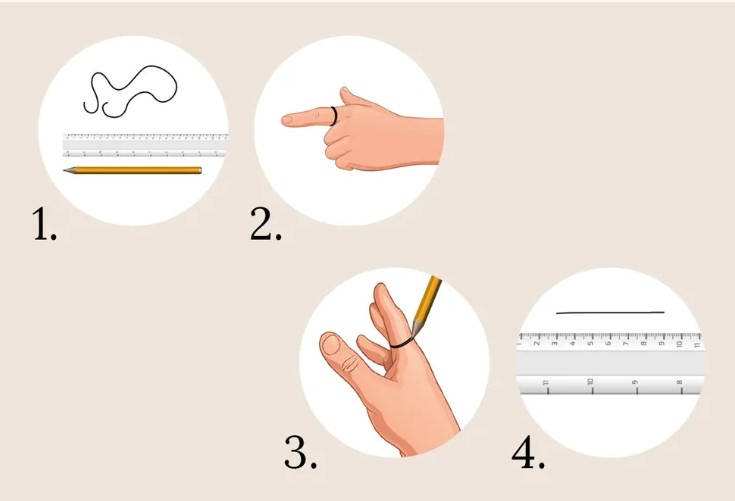
You don’t need to buy expensive tools to measure ring size—these common household items work just as well: 1) String or Dental Floss: Thin, flexible, and easy to wrap around the finger. 2) Paper Strip: Cut a 1-inch wide strip from a piece of paper (avoid thick cardstock, which is too rigid). 3) Ruler: A standard ruler with millimeters (for precise measurements—ring sizes are based on circumference, which is easiest to calculate in mm). 4) Marker or Pen: To mark the string/paper where it overlaps. 5) Scissors: To cut the string or paper strip to size. These items are ideal for quick measurements at home, especially if you’re measuring someone else’s finger secretly.
Printable Ring Size Guides (Free & Convenient)
Printable ring size guides are a popular option—most jewelers (like James Allen, Blue Nile, and Kay Jewelers) offer free downloadable guides on their websites. These guides include two tools: 1) A finger sizer: A strip of paper with pre-marked sizes that you wrap around the finger. 2) A ring comparator: A chart with circles that match standard ring sizes—you place an existing ring over the circles to find the perfect fit. To use a printable guide correctly, make sure to print it at 100% scale (no zooming in or out) and verify the size with a ruler (most guides include a 1-inch reference mark to check accuracy).
Professional Tools (For Extra Precision)
If you want the most accurate measurement (or are buying a high-value ring), consider these professional tools: 1) Ring Sizer Set: A set of plastic or metal rings in standard sizes (1–13 for women, 8–16 for men) that you try on to find the best fit. Available for $5–$15 online or at craft stores. 2) Digital Caliper: Measures the diameter of an existing ring in millimeters, which you can convert to a size using a chart. Ideal for measuring rings you already own. 3) Jeweler’s Mandrel: A metal rod marked with ring sizes—jewelers use this to measure rings, but it’s less useful for measuring fingers directly. Professional tools are great for engagement rings or custom pieces where precision is critical.
Step-by-Step Methods to Measure Ring Size
Method 1: String or Dental Floss (Best for Secret Measurements)
This method is perfect if you’re measuring someone else’s finger without them noticing (e.g., for a surprise proposal or gift). Follow these steps:
-
Prepare the string: Cut a piece of string or dental floss about 6 inches long—this gives you enough length to wrap around the finger and hold onto.
-
Wrap around the finger: Wrap the string snugly around the base of the finger where the ring will sit. Make sure it’s not too tight (you should be able to slide one finger under the string) and not too loose (it shouldn’t slide around).
-
Mark the overlap: Use a marker to make a small dot where the string overlaps itself. This marks the circumference of the finger.
-
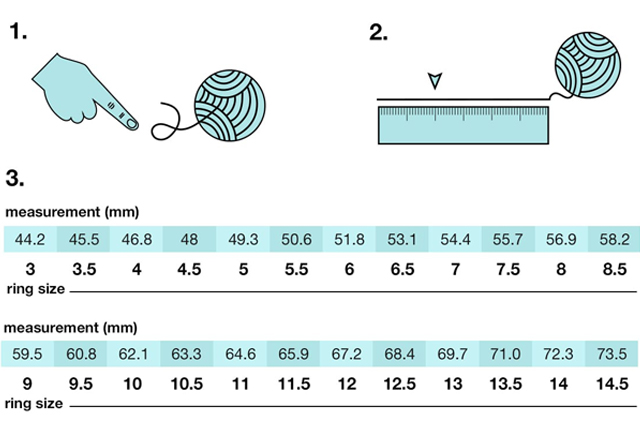
Measure the length: Lay the string flat on a ruler and measure the distance from the start of the string to the marked dot, in millimeters (mm). This is the finger’s circumference.
-
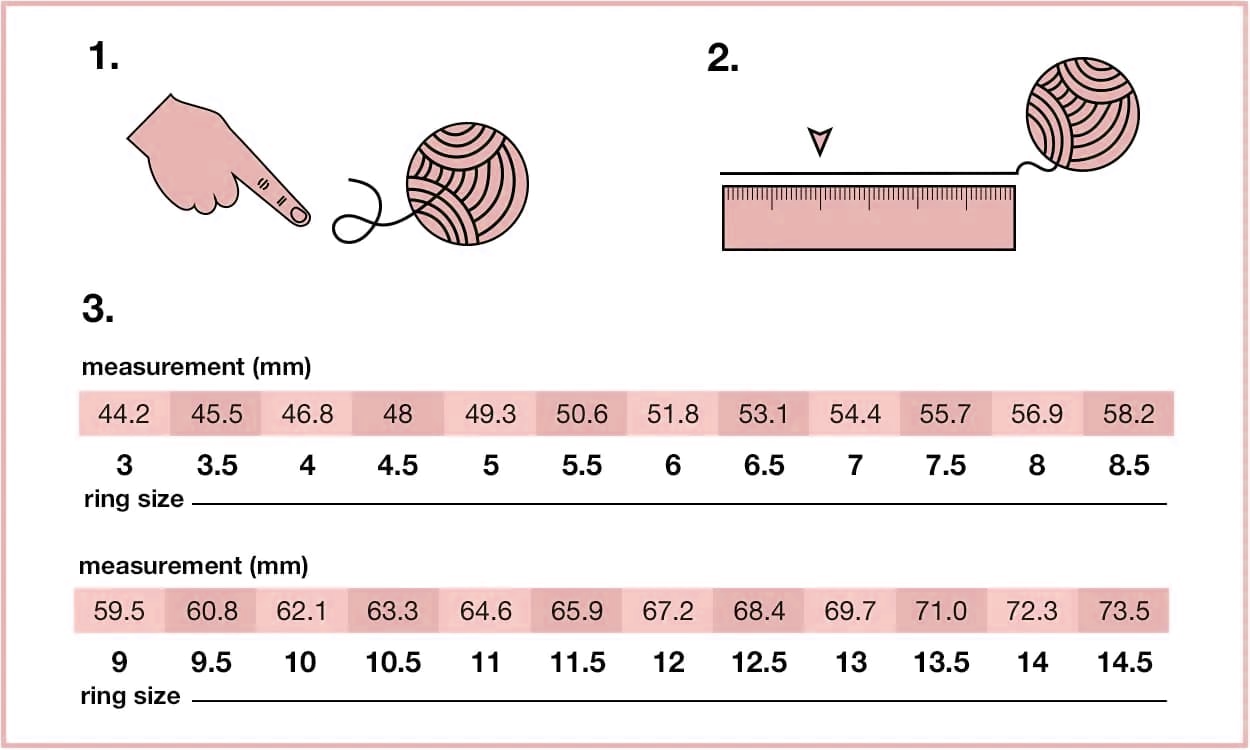
Convert to ring size: Use a ring size chart (see below) to find the size that matches the circumference. For example, a circumference of 54mm = size 6 (US), 56mm = size 7 (US).
Method 2: Paper Strip (More Durable Than String)
A paper strip is sturdier than string, making it easier to wrap and mark accurately. Here’s how to use it:
-
Cut the paper: Cut a strip of paper 1 inch wide and 6 inches long. Fold one end over slightly to create a tab—this helps it stay in place while wrapping.
-
Wrap around the finger: Slide the paper strip over the finger and wrap it around the base, with the tab on top. Pull it snug (but not tight) and mark where the end of the strip overlaps the tab.
-
Measure the width: Cut the paper strip at the mark, then lay it flat on a ruler to measure its length in mm. This is the finger’s circumference.
-
Find your size: Use a ring size chart to convert the circumference to a US, UK, or EU size (most jewelers list sizes in multiple standards).

Method 3: Use an Existing Ring (Fastest for Known Fits)
If the person already owns a ring that fits the same finger (e.g., a wedding band or everyday ring), use this method to skip measuring the finger directly:
-
Measure the diameter: Lay the ring flat on a ruler and measure the distance across the center of the ring (from one inner edge to the other) in mm. This is the ring’s diameter.
-
Calculate circumference: Multiply the diameter by 3.14 (pi) to get the circumference. For example, a diameter of 17.2mm x 3.14 = 54mm circumference (size 6 US).
-
Check with a comparator: If you have a printable ring size guide, place the ring over the pre-sized circles to find the match—this is faster than calculating manually.
Pro Tip: Make sure the existing ring fits the same finger you’re buying for—ring sizes vary between fingers (e.g., most people’s ring finger is smaller than their index finger).